Standard-Profile Split Keyboards: Six Models Compared


Why standard profile, and not low profile?
We previously compared six low-profile split keyboards. That article covers the thin end of the category — split layouts built around Kailh Choc and similar switches.
This one covers the other half: split keyboards that take normal-height switches. The ergonomic argument for splitting is the same — you place each half at shoulder width instead of pulling your arms inward — but the trade-offs are different.
Going standard profile costs you some desk height. It buys you three things in return:
- The full switch catalog. Low-profile boards limit you to Choc-compatible switches, a small fraction of what exists. Standard-profile boards take MX-style switches, which is essentially everything.
- Familiar key spacing and travel. No relearning period on the keys themselves. If you already type on a normal keyboard, only the split takes adjustment.
- Better acoustics. A thicker case has room for foam, gasket mounts, and plate material choices. Low-profile boards structurally cannot do much here.
KeyLab DB currently lists 12 split keyboards with standard-profile switch support. Below are six of them, plus one that sits outside the category but is worth knowing about. All specifications come from the KeyLab DB listings (unlisted fields are shown as "—").
Spec table
| Model | Keys | Case | Plate | Mount | Connectivity | Hot-swap | Firmware | Battery | Weight |
|---|---|---|---|---|---|---|---|---|---|
| Keychron Q11 Ultra 8K | 89 | CNC Aluminum | PC | Gasket | USB-C + Bluetooth + 2.4 GHz | Yes | Custom | 4000 mAh | 1724 g |
| Mistel MD770PRO | 85 | Aluminum | Steel | — | USB-C + Bluetooth + 2.4 GHz | Yes | VIA | 3000 mAh | 1325 g |
| Filco Xacro M10SP | 72 | ABS | Aluminum | PlateMount | USB-C | No | Custom | — | 840 g |
| EPOMAKER Split70 | 71 | Plastic | PC | Gasket | USB-C + Bluetooth + 2.4 GHz | Yes | QMK/VIA | 3000 mAh | 890 g |
| NocFree Lite | 63 | ABS Top + PC Bottom | FR4 | Gasket | USB-C + 2.4 GHz | Yes | VIA | 3600 mAh | 560 g |
| Mistel MD600 Alpha | 64 | ABS | — | Tray | USB-C + Bluetooth | Yes | Custom | 2000 mAh | 850 g |
| REALFORCE RS1 (bonus) | 79 | ABS | Steel | PlateMount | USB-C | No | Custom | — | 750 g |
Keychron Q11 Ultra 8K
Of everything here, the Q11 Ultra 8K is the most ambitious build. The DB lists a CNC aluminum case with a PC plate on a gasket mount, and at 1724 g it is the heaviest board in this comparison by a wide margin.
Connectivity is tri-mode — USB-C, Bluetooth, and 2.4 GHz — with a 4000 mAh battery, the largest here. The headline claim is an 8K polling rate in wireless mode, achieved with a dual-chip design. Wireless boards usually concede polling rate; this one does not. Dimensions are 345.08 × 133.97 × 17.83 mm per the listing, and it runs ZMK firmware configured through Keychron Launcher.
Two caveats. The DB lists no RGB, which may or may not matter to you. And ZMK is not QMK — if you specifically want a QMK/VIA workflow, note that the standard Keychron Q11 is the QMK/VIA model, though it is wired-only and not hot-swappable.
This is the pick if you want a split keyboard that feels like a custom board rather than an ergonomic accessory, and you are willing to carry the weight.
Mistel MD770PRO
The MD770PRO is the closest thing here to a direct competitor to the Q11 Ultra, and it takes a different route to a similar place.
The listing gives a full CNC aluminum case with a steel plate and a layered internal structure that Mistel describes as tuned for typing feel and sound. At 85 keys it has the highest key count of any board in this comparison — closer to a 75% layout per half than the compact layouts most split boards settle for. Connectivity is tri-mode with a 3000 mAh battery, it is hot-swappable, and it supports VIA. Dimensions are 331 × 135 × 37 mm at 1325 g.
Mistel
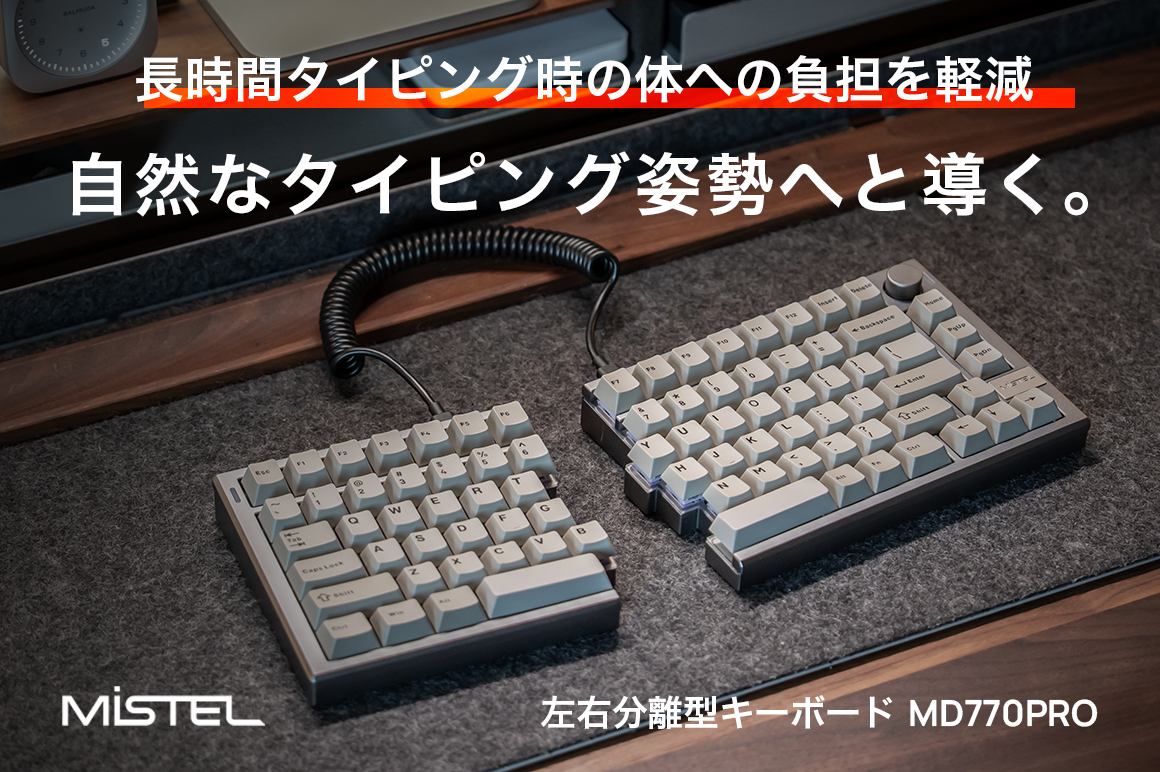
The DB lists factory switch options of KTT Hyacinth (linear) and HMX Peach Pink (silent linear), so there is a quiet variant available out of the box.
If you want VIA rather than a proprietary configurator, and you do not want to drop down to a 60%-class layout, this is the strongest all-rounder in the group.
Filco Majestouch Xacro M10SP
The Xacro M10SP is the outlier, and the most interesting board here for a specific kind of user.
It is a split 65% with 72 keys in an ABS case with an aluminum plate, plate-mounted, at 336 × 122 × 38 mm and 840 g. What sets it apart is the 10 dedicated macro keys in the center section — a genuinely unusual choice, and the reason to consider it over anything else in this list.
Programming does not require software: DIP switches select QWERTY, Dvorak, Colemak, or Mac layouts, and remapping happens through on-board key sequences, storing up to 8 profiles across 3 layers. Windows users get the optional Filco Assist software. The listing also notes a silicone dampening pad between plate and PCB, a USB passthrough port, and four removable tilt stands.
The trade-offs are real: not hot-swappable, wired only, and no RGB. You choose your switches once, at purchase. But for someone who wants macro keys within reach and configuration that survives without a driver installed, nothing else here comes close.
EPOMAKER Split70
The Split70 is the value-oriented entry, and its spec sheet is more complete than the price positioning suggests.
The DB lists 71 keys, a PC plate on a gasket mount, hot-swap support, QMK/VIA, a 3000 mAh battery, per-key RGB, and Cherry-profile PBT keycaps. The case is plastic rather than metal, which is where the cost comes out, and total weight is 890 g. The listed 188 × 118 × 40 mm is the measurement for one half.
Epomaker

Connectivity is tri-mode — USB-C, Bluetooth, and 2.4 GHz — which is generous at this price. Factory switches are listed as 5-pin linear, factory lubed.
The key layout deserves a warning, though. Key positions differ from EPOMAKER’s own Split65; the Split70 uses its own arrangement to fit 71 keys across the two halves. Coming from any other board — including the Split65 — expect your fingers to need retraining, and budget for a stretch of typos while you adjust.
Gasket mount plus QMK/VIA plus hot-swap on a plastic-case board is a strong combination. This is the easiest recommendation for a first split keyboard where you are not certain the format will suit you.
NocFree Lite
If the NocFree & from our low-profile roundup appealed to you but you want standard switches, the NocFree Lite is the same design language in a normal-height package.
At 560 g it is by far the lightest board here — roughly a third of the Q11 Ultra. The listing gives 63 keys, an ABS top with PC bottom, an FR4 plate on a gasket mount, hot-swap, VIA, per-key RGB, and a 3600 mAh battery (the second largest in this comparison, which is notable given the weight). Dimensions are 300.8 × 112.4 × 30.5 mm, and compatibility covers Mac, Windows, and Linux.
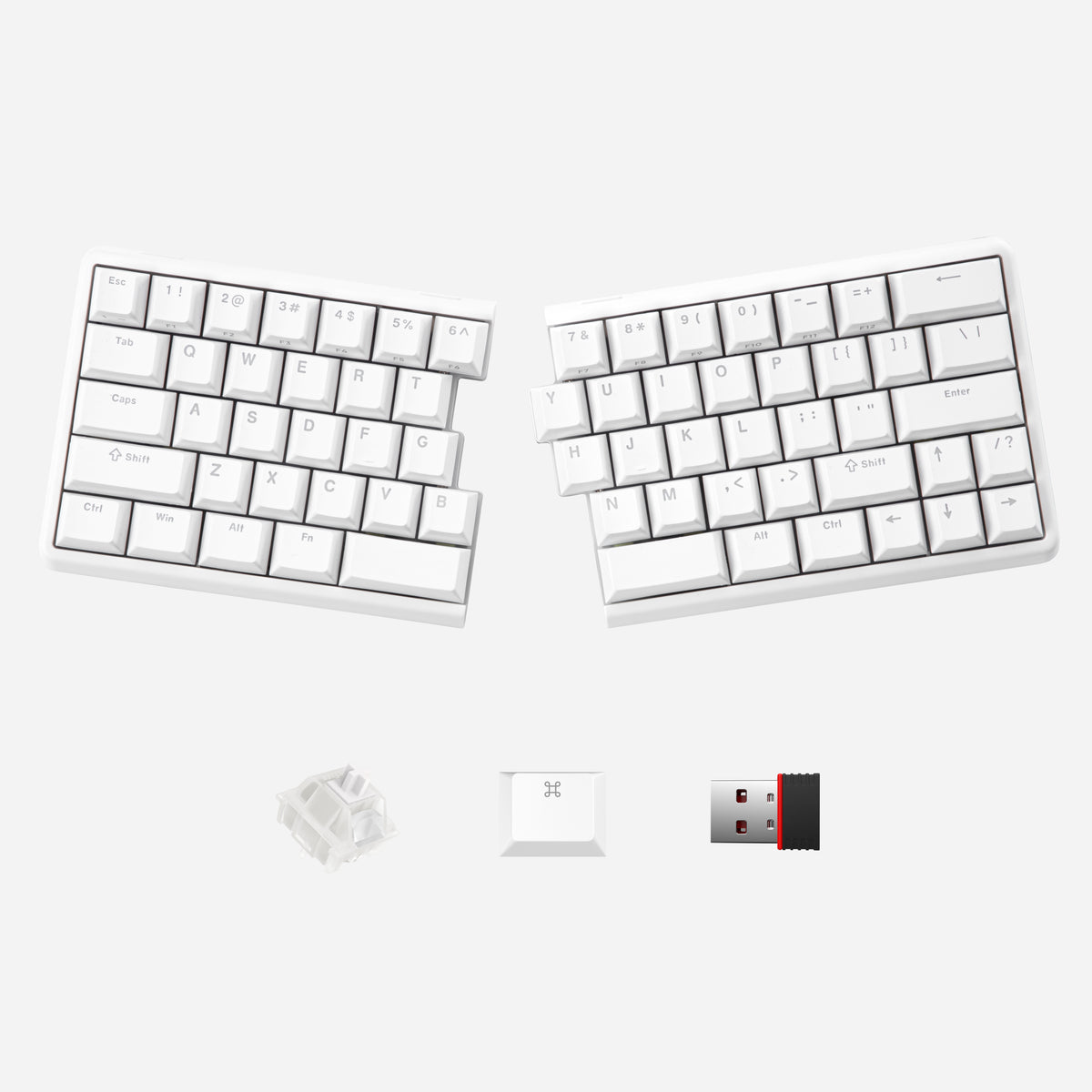
Connectivity is USB-C and 2.4 GHz, with no Bluetooth. If you switch between devices over Bluetooth, that is a meaningful gap. Sound-absorbing foam is listed as an add-on rather than included, so budget for it if acoustics matter.
This is the pick if you move your keyboard around — between home and office, or on and off a desk — and want gasket mount and VIA without the mass.
Mistel MD600 Alpha
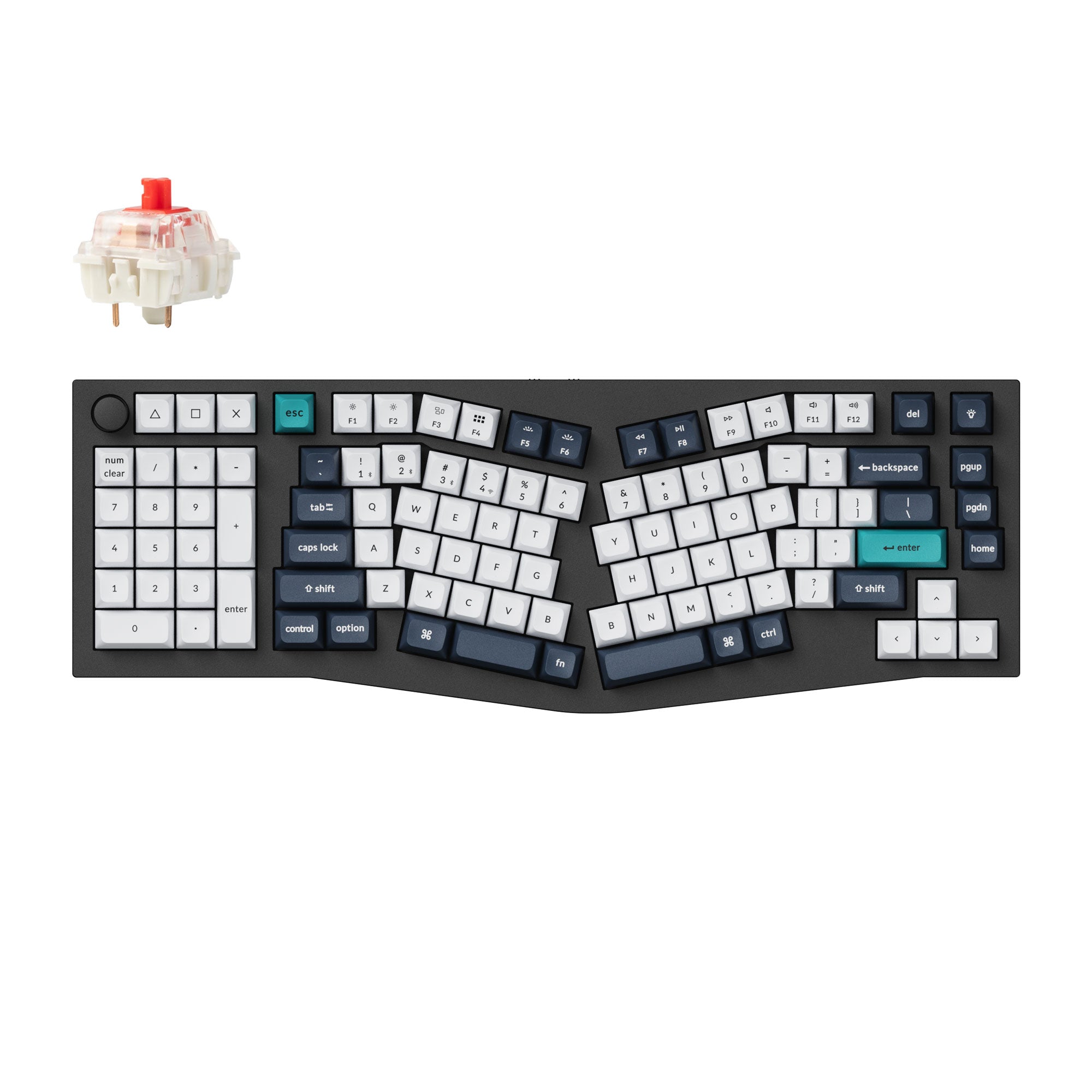
The MD600 Alpha is the only board here using an Alice-style layout, and that single fact should decide whether it is on your list.
An Alice layout angles the two halves inward at a fixed rotation, rather than letting you position them freely. The listing describes it as a compact ergonomic split Alice layout with 64 keys in an ABS case, tray mounted, at 325 × 110 × 35 mm and 850 g. It is hot-swappable, supports Bluetooth 5.0 and USB-C, carries a 2000 mAh battery, and offers 3 programmable macro layers with double-shot PBT keycaps and per-key RGB. Internal sound dampening material is listed.

Understand what you are choosing. An Alice layout gives you most of the wrist-angle benefit of a split with none of the placement freedom — the halves stay fixed relative to each other. For some people that is the right compromise, because it needs no desk reorganization and you cannot lose the alignment. For others, free placement is the entire point of buying a split.
Bonus: Topre REALFORCE RS1
The REALFORCE RS1 sits outside this comparison's strict boundary — it uses capacitive non-contact switches, not mechanical ones — but it is the only split board of its kind in the catalog and deserves a mention.
Topre's capacitive mechanism is a different animal from MX-style switches: a rubber dome over a conical spring, with the keypress detected by a change in capacitance rather than a physical contact. The listing covers 79 keys in a Japanese layout, an ABS case with a steel plate, plate-mounted, 326 × 138 × 38 mm at 750 g, USB-C wired, and customizable keypress force.

It is not hot-swappable and has no RGB or wireless. But capacitive switches have a following that MX switches do not fully overlap with, and if that is you, this is currently the only split option available.
Which one to pick
- A custom-grade build, wireless, no compromise on polling rate → Keychron Q11 Ultra 8K. Accept 1724 g and ZMK instead of QMK.
- The best balance, with VIA and a full-size key count → Mistel MD770PRO. The strongest all-rounder if you do not want a proprietary configurator.
- Macro keys and driver-free configuration → Filco Xacro M10SP. You give up hot-swap and wireless for something nothing else offers.
- Trying a split for the first time → EPOMAKER Split70. Gasket mount, QMK/VIA, hot-swap, and tri-mode wireless at the lowest risk — allow for a break-in period on the unusual key layout.
- Portability above all → NocFree Lite. 560 g with a 3600 mAh battery is a hard combination to beat.
- A fixed ergonomic angle, not free placement → Mistel MD600 Alpha. Choose it for the Alice layout, not despite it.
- Capacitive switches → REALFORCE RS1. The only option in the category.
For the full set of candidates and current specs, use the split keyboard filter on KeyLab DB. If you want the thin versions instead, our low-profile split comparison covers those.